TRAPPN#153: John Whitney’s “Catalog”
John Whitney, “Catalog” (1961)
It’s still a good idea.
Its exercise is discipline:
to remember to cross the street without looking,
to remember not to jump when the cars side-swipe,
to remember not to bother to have clothes cleaned,
to remember not to eat or want to eat,
to consider the numerous methods of killing oneself,
that is surely the finest exercise of the imagination:
death by drowning, sleeping pills, slashed wrists,
kitchen fumes, bullets through the brain or through
the stomach, hanging by the neck in attic or basement,
a clean frozen death—the ways are endless.
And consider the drama! It’s better than a whole season
at Stratford when you think of the emotion of your
family on hearing the news and when you imagine
how embarrassed some will be when the body is found.
One could furnish a whole chorus in a Greek play
with expletives and feel sneaky and omniscient
at the same time. But there’s no shame
in this concept of suicide.
It has concerned our best philosophers
and inspired some of the most popular
of our politicians and financiers.
Some people swim lakes, others climb flagpoles,
some join monasteries, but we, my friends,
who have considered suicide take our daily walk
with death and are not lonely.
In the end it brings more honesty and care
than all the democratic parliaments of tricks.
It is the ‘sickness unto death’; it is death;
it is not death; it is the sand from the beaches
of a hundred civilizations, the sand in the teeth
of death and barnacles our singing tongue:
and this is ‘life’ and we owe at least this much
contemplation to our western fact: to Rise,
Decline, Fall, to futility and larks,
to the bright crustaceans of the oversky.
– Phyllis Webb, “To Friends Who Have Also Considered Suicide”
My creative writing class is turning me into a poetry fan!
SOURCE: ROB MCLELLAN’S BLOG, starsfadein
by Saul Ostrow
BOMB 85 – Fall 2003
Sol LeWitt, Wall Drawing #1081: Planes of Color. Kunstsammlungen, Chemnitz, Germany, March 2003.
“Interviewing Sol LeWitt required a ride into the Connecticut countryside, where he lives with his wife and daughters. Many of the artists associated with Minimalism fled contemporary art’s urban setting as soon as they could. This set me to thinking about the nature of Minimalism and the complex and often paradoxical role that LeWitt’s work plays in its development.
One of the interesting things about living through a period is that you know where the neat and tidy hindsight of recorded history and the happenstance of the moment diverge. I have known LeWitt since my days as an art student in New York in the ‘60s. At that time he was one of the hard core of Minimalist artists that included the sculptors Donald Judd, Dan Flavin and Robert Smithson as well as the painters Jo Baer, Robert Ryman and Robert Mangold. Their works were characterized by an austere industrial aesthetic and reductivism that made their pieces seem highly impersonal, intellectual and urban. Yet as LeWitt moved from making systemic objects to wall drawings and eventually what can only be called murals, his use of plans, diagrams and instructions emphasized the ideas that circumscribed his work and the nature of those decisions that constitute an artist’s taste and aesthetic vision—or in LeWitt’s case, those of the people hired to execute his work.
LeWitt’s work calls our attention to the disparity between the world of language and that of objects and actions. By focusing on the disjunction between these terms, LeWitt bridged the gap between Minimalism and Conceptual art. As an artist he is intent on both making art just another object in the world and seeking to dematerialize it. Although LeWitt’s works of the last 20 years is still premised on the tension that exists between what can be said and what can be shown, the murals, wall drawings and sculptures he now produces are increasingly eccentric in form and individualistic in execution. After lunch at a café in town, a visit to the local synagogue that he designed and the warehouse were he stores his vast collection, Sol LeWitt and I retired to the comfort of his living room to excavate the past and shed light on the present.
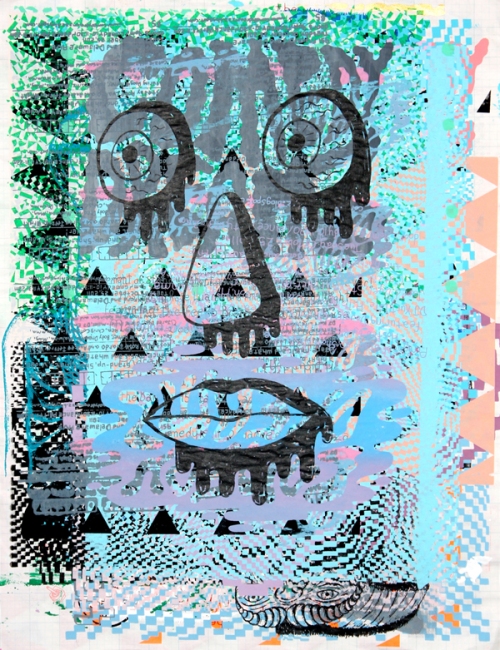
Really love the amateurish quality of his work. Reminds me of Pootoogook. Supposedly he’s mad influenced by Hockney. OBVS. He is based in Los Angeles.
DAVID KORTY IN THE GUARDIAN UK
Going to check out the opening of Hunter & Cook‘s Toronto headquarters tonight. It’s also the opening of Sam Falls’ solo ex entitled “Mexico City Wall Art” which incorporates his work with acrylics and pastels on photos. I’m excited. See you there.
Hernández Cornet SS12
Love the shoes! Love those deconstructed skirts!
Cornet is based out of Sweden
SOURCE: anywho, talldarkroast
“My photographs are documentations of sculptures and installations but they are also records of actions and elaborate processes. Days are spent, sometimes with a crew but more often in solitude, silently driving, carrying supplies, erecting structures and sets, and studying the slow progress of the sun overhead and its all-powerful, comfort-giving and –taking effects. Created in close collaboration with the movements of the sun, precisely observed, I see my photographs as acts of reverence and participation in a deep, reassuring natural order outside of and much larger than myself.”
Really digging the post on the work of Chris Engman over on We Find Wildness.
Chris is based out of Seattle.
I’m still on it; I’m still TRAPPN.